

Dynamics 365 Business Central has become one of the most commonly shortlisted ERPs for small and mid-sized distributors. This is especially true in cases where companies outgrow light-weight accounting systems such as QuickBooks or when they are replacing aging on-prem systems.
There are key reasons for the platform’s popularity. Distributors need tight inventory control, fast order processing, and financial reporting they can trust; and they need a system that can grow with them without adding operational friction and overhead. Business Central sits in that middle ground. It is structured enough to support complexity, but it would not slow the organization down.
Still, shortlisting Business Central for distribution companies is only half the equation. The other half lies in how it is evaluated and how it is implemented. Operational leaders and financial leaders often measure success differently, yet both depend on the same system design.
The operational lens asks: Will this improve efficiency and operational reliability?
The financial lens asks: Will this improve efficacy and reporting integrity?
A strong implementation satisfies both.
What to evaluate when selecting Business Central for distribution
ERP evaluations often focus on surface functionality. Assessing features such as inventory management, reporting, and the ability to integrate with existent systems is admittedly important. However, this level of validation is not enough for distribution environments where daily exceptions define reality.
1. Inventory management must reflect how goods actually move
Business Central includes robust inventory capabilities such as lot and serial tracking, multi-location visibility, bin management, and assembly functionality. On paper, this checks the box for most distributors.
The real question is how those capabilities behave under pressure. What happens when partial shipments are common? When substitutions occur? When stock is transferred between warehouses daily? When receiving and put-away do not follow clean sequencing?
If those workflows are not tested using real scenarios during evaluation, inventory accuracy becomes theoretical. And in distribution, theoretical accuracy quickly translates into service issues and margin erosion.
2. Order-to-cash must support scale without introducing bottlenecks
Distribution is ultimately a volume game. Margins tighten when orders slow down or require constant manual intervention.
So, your ERP evaluation should move beyond features and function, and examine the flow of operations. Consider questions such as: Can orders move from entry to fulfillment without repeated overrides? Can warehouse teams rely on system data when picking? Can finance trust that invoices reflect what was actually shipped? Speed without control increases risk. Control without speed increases cost. The ERP must support both simultaneously.
3. Financial structure must be designed, not improvised
One of the most powerful aspects of Business Central for distribution is its dimensional reporting structure. Dimensions allow distributors to analyze performance by product line, location, channel, or customer segment without overcomplicating the chart of accounts.
When dimensions are thoughtfully implemented, finance gains margin clarity and working capital visibility without adding reporting overhead. When they are treated as an afterthought, reporting becomes fragmented and reconciliation-heavy.
4. Scalability depends on architecture, strategy, and functionality
Business Central is a highly scalable platform, but its long-term success depends more on the extensibility strategy your organization adopts. If the strategy to extend your ERP is reactive, it becomes surrounded by disconnected systems. If the extension strategy is deliberate, Business Central remains the operational and financial backbone. Scalability is less about adding features and more about protecting structure.
As distributors grow they can extend Business Central with 3rd party solutions and service offerings for EDI, scanners, specialized logistics tools, and much more. Some of these are offered in bundles such as ACE Micro’s packaged implementation for distributors.
Core capabilities in Business Central for distribution
It is worth being clear about what Business Central brings to a distribution environment beyond accounting.
The platform provides real-time inventory valuation, replenishment planning, and purchasing workflows that connect directly to financial posting. Warehouse functionality supports bin tracking and controlled movement of goods. Item tracking enables lot and serial number control for compliance and traceability. Reporting integrates seamlessly with Power BI, allowing operational and financial metrics to be viewed in context rather than isolation.
In practical terms, this means fewer disconnected spreadsheets, fewer reconciliations between warehouse and finance, and clearer margin analysis by product and location.
Business Central for distribution works best when those capabilities are treated as an integrated system rather than separate modules.
What matters after you choose Business Central
Selection creates momentum. Implementation determines whether that momentum compounds or stalls.
The first priority should be operational clarity. Receiving, put-away, picking, shipping, and replenishment processes must be mapped before configuration begins. When configuration reflects actual warehouse flow, adoption improves and resistance declines.
The second priority is reporting alignment. Operational dashboards and financial reports should be defined early, not after go-live. Business Central supports real-time visibility, particularly when paired with Power BI, but clarity depends on structure established during implementation.
The third priority is governance. Extensions such as warehouse scanning, EDI, or advanced pricing should be planned as part of the architecture rather than layered in response to friction. A controlled ecosystem keeps Business Central central.
So, is Business Central good for distribution companies?
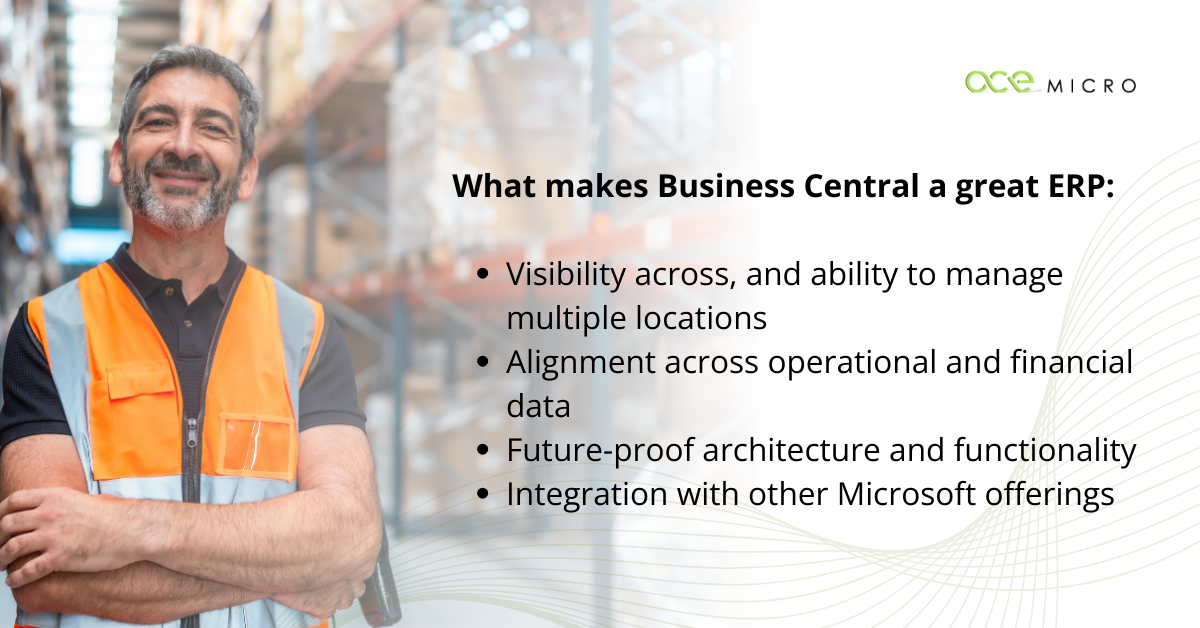
For most small to mid-sized distributors, the answer is absolutely yes. It offers meaningful inventory control, financial transparency, and Microsoft ecosystem integration without the overhead of enterprise-tier ERP platforms.
It is particularly strong for organizations that:
- Require multi-location inventory visibility
- Need financial reporting aligned to operational data
- Want cloud scalability without complex infrastructure
- Plan to integrate with Microsoft 365, Power Platform, or Dynamics 365 solutions
The difference between replacing software and finding a solution
Business Central for distribution can stabilize operations and strengthen financial insight. But that outcome is not automatic.
The companies that see measurable improvement approach implementation as structural alignment, not just system deployment. They treat inventory flow, reporting design, and extension governance as interconnected decisions.
Selecting the ERP sets direction. Designing it with discipline determines whether it becomes a competitive advantage or simply a newer interface over familiar inefficiencies.