
Most ERP decisions feel settled once the implementation is scoped and signed. The timeline is clear, the cost is defined, and the focus shifts to delivery. What tends to receive less attention is how the system will be supported once it is live. That detail often sits in the background until the first real issue appears, or until a user needs help and is unsure whether asking the question will trigger an additional cost.
That moment comes quickly. A report does not get generated as expected, a process behaves slightly differently than anticipated, or a new user needs guidance. At that point, the importance of reliable support becomes clearer than ever. The support model offered by your implementation partners affects how confidently your team uses the system and how quickly issues are resolved
For organizations implementing Microsoft Dynamics 365 Business Central, this shift is especially immediate as the platform is continuously enhanced and transformed. The system shifts from project to operational dependency, and the quality of support begins to shape how much value you actually get from it.
Why a Low Implementation Cost Can Create a Longer-Term Problem
A lower implementation quote can be appealing during initial evaluation. It suggests efficiency and a tightly controlled scope. In many cases, that price reflects a narrow definition of what is included. The system is configured, data is migrated, and go-live is achieved, but anything outside that initial scope becomes an additional request. When every question, adjustment, or clarification is billed by the hour, teams start to change their behavior. They pause before raising issues. They work around inefficiencies. They delay improvements that would otherwise be straightforward.
This is particularly noticeable in operational environments where processes are interconnected. In distribution businesses, for example, inventory movement, order fulfillment, and warehouse execution rarely stay static. Small adjustments are part of normal operations. When support is constrained, those small adjustments tend to be postponed. Over time, the gap between how the system was designed and how the business actually operates begins to widen.
Where Hourly Support Shifts Control Away From You
Hourly support models introduce a level of uncertainty that is difficult to manage. It is rarely clear how many support requests will be needed after go-live or how many refinements will be required to align the system with real-world operations. That uncertainty sits with the client, where costs fluctuate based on unpredictable usage.
That uncertainty sits with the client. Costs fluctuate based on usage, and usage is difficult to predict. From the hourly partner’s perspective, the model is straightforward. Time is tracked and billed, regardless of whether the underlying issue stems from user questions, process gaps, or initial design decisions.
This structure also shapes how implementation is approached. When support is billed separately, there is less commercial pressure to minimize future support demand. The risk of gaps, misunderstandings, or incomplete alignment does not fully sit with the partner. Over time, this creates a dynamic where the client manages both operational complexity and cost variability, while the partner operates within a more predictable framework.
Why We Structure Support Differently
At ACE Micro, we structure our projects around a fixed cost model to remove uncertainty and accelerate time to value. Once the system is live, unlimited support is built in, giving teams the space to adopt, refine, and use the solution without worrying about incremental costs.
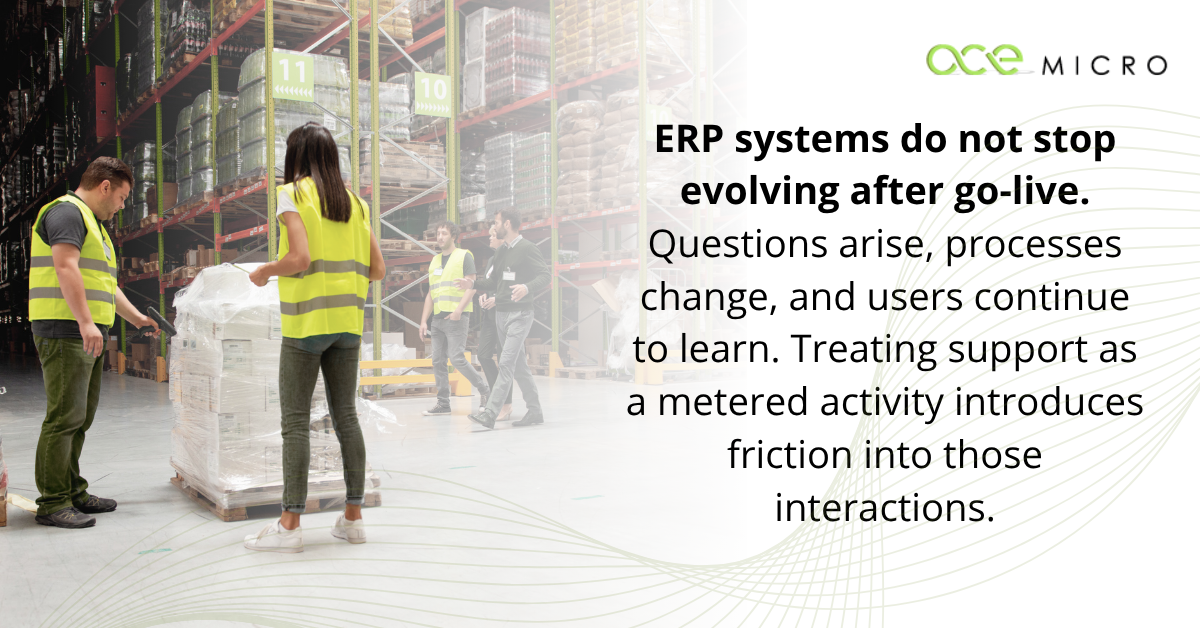
The reasoning is practical. ERP systems do not stop evolving after go-live. Questions arise, processes change, and users continue to learn. Treating support as a metered activity introduces friction into those interactions. Removing that friction allows teams to engage with the system more directly.
When support is unlimited within a defined scope, cost of ownership becomes predictable. There are no incremental charges for asking questions or making small adjustments. That clarity makes it easier to plan and removes the hesitation that often slows down adoption.
It also changes the incentives on both sides. When support is not tied to billable hours, the focus shifts toward delivering a system that works well from the start and continues to improve over time. Fewer issues, clearer processes, and better user understanding benefit both the client and the partner.
The First Year Is Where the Real Work Happens
The period immediately after go-live carries more weight than expected. This is when the system is used under real conditions, with real data and real operational pressure. Edge cases appear, reporting requirements evolve, and integrations are tested in practice.
In distribution-focused organizations, this can include live order cycles, shifting inventory levels, and warehouse execution under time constraints. These are not edge scenarios. They are daily realities. If support is limited during this phase, teams often adapt by working around the system. They revert to manual processes, delay improvements, and avoid raising questions that feel non-essential. These patterns tend to persist, even when better solutions are available.
With unlimited support in place, teams can address issues as they arise. Questions are resolved quickly, processes are refined continuously, and confidence in the system builds over time. The ERP becomes part of the workflow rather than something that sits alongside it.
Reducing Friction in Everyday Use
Beyond go-live stabilization, the impact of unlimited support is most visible in everyday use. A finance team encounters a posting issue during month-end close. An operations team needs to adjust a workflow to reflect a change in supplier timing. A new user needs clarification on how to handle a specific scenario.
In an hourly model, each of these situations carries a cost consideration. That consideration delays resolution. In an unlimited model, the path is clearer. The issue is raised, addressed, and resolved without the added layer of cost evaluation.
Over time, this reduction in friction improves how the system is used. Teams engage more freely, issues are addressed earlier, and the system stays aligned with the business. The cumulative effect is a smoother, more effective operation.
When selecting a partner for Microsoft Dynamics 365 Business Central, support should be part of the initial evaluation. Implementation approach and technical capability are important, but they do not fully determine long-term success.
It is worth asking how support is delivered, how costs are structured, and how the partner remains engaged after go-live. In environments where operations are complex and interconnected, such as distribution, these questions become even more important.
If you are planning a move to Microsoft Dynamics 365 Business Central, it is worth looking beyond the implementation quote. The first year after go-live should be considered part of the project, not a separate phase. Think about how your teams will interact with the system, how often they will need support, and how quickly you want to refine your processes. In environments that involve inventory, fulfillment, and multi-location operations, that need tends to be ongoing rather than occasional.
If cost predictability, ease of engagement, and long-term system performance are priorities, the support model you choose will directly shape the outcome. It provides clarity where uncertainty often exists and allows your team to focus on using the system effectively rather than managing the cost of using it.
If you are evaluating ERP options or reassessing your current support structure, connect with the ACE Micro team today. We will help you understand how a fixed cost approach with unlimited support changes cost predictability, adoption, and long-term system performance.